
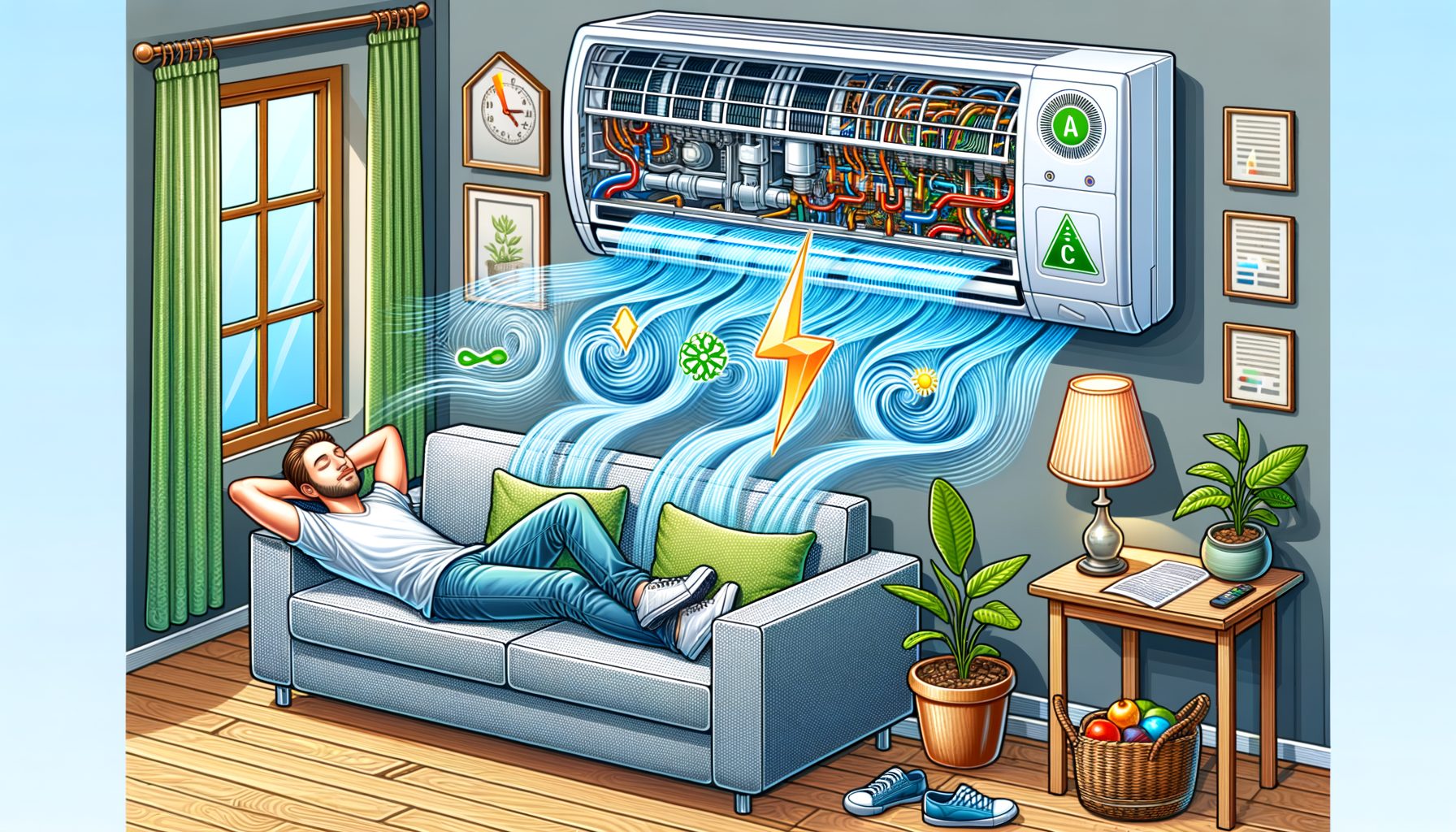
Cooling your home shouldn’t trigger jaw-dropping power bills or rooms that swing from frigid to stuffy. Feeling stuck between heat, noise, and cost? You’re not alone. Good news: inverter air conditioners tackle all three at once. By matching compressor speed to the exact cooling or heating load, they trim energy use while holding temperature steady. In the guide below, you’ll see how the technology works, what the savings look like, the features that matter, and the habits that unlock maximum comfort and efficiency.
The problem with conventional ACs—and how inverter technology fixes it
Traditional non-inverter air conditioners behave like a light switch—either fully on or completely off. Such start–stop behavior wastes electricity. Each time a fixed-speed compressor restarts, it pulls a surge of current, blasts cold air, and overshoots the set temperature. The cycle repeats, leading to temperature swings, more noise, and extra wear on components. In hot, humid weather, short bursts also fail to remove enough moisture, so rooms feel clammy even when the thermostat claims you’re on target.
Inverter air conditioners trade that crude switching for precision. A variable-speed compressor, driven by an electronic inverter, modulates output in real time. Rather than blasting at 100% and shutting off, the system ramps gently and runs at the lowest power needed to hold your setpoint—often cruising at 30–60% capacity. Here’s where the magic happens: compressors are most efficient at part load, and avoiding frequent restarts eliminates inrush currents and thermal losses. The upshot is smoother temperatures, quieter operation, and substantial energy savings.
How much can you save? Field studies and manufacturer data commonly show 30–50% lower energy use than comparable non-inverter units across a typical cooling season. Seasonal efficiency ratings reflect the same advantage. In many markets, non-inverter split systems land around SEER 10–14, while modern inverter models routinely reach SEER 18–25 and beyond. In Europe and parts of Asia, the equivalent seasonal metrics (SEER/CSPF for cooling, SCOP/HSPF for heating) tell the same story: more cooling per watt over the season because most hours are spent at efficient partial load.
Beyond pure efficiency, comfort is protected. Because output is continuously modulated, temperature typically stays within a tight band, often ±0.5°C (±1°F). Steady-state operation also wrings out humidity more effectively, making rooms feel cooler at a higher thermostat setting. And with the compressor no longer slamming on and off, sound levels drop—often down to whisper-quiet—especially at night. Together, those benefits explain why inverter air conditioners have become the default in many regions.
Real-world savings, payback, and comfort benefits
Let’s turn the engineering into everyday numbers. Imagine two 1.5-ton (≈18,000 BTU/h) split systems: a non-inverter rated around SEER 10 and an inverter at SEER 20. A rough power draw for steady cooling equals BTU/h divided by SEER. At SEER 10, the non-inverter needs about 1,800 watts; at SEER 20, the inverter needs about 900 watts for the same output. Over 1,200 hours per year, that’s roughly 2,160 kWh versus 1,080 kWh—about 1,080 kWh saved. At $0.20 per kWh (use your local rate), the annual saving is about $216. If the inverter model costs $400 more upfront, simple payback lands under two years—and that figure doesn’t count better comfort or potentially lower maintenance.
The climate impact is meaningful too. Using a conservative grid emissions factor of 0.4 kg CO2 per kWh (yours may differ), saving 1,080 kWh avoids about 430 kg of CO2 each year. Over a 10–12 year lifespan, that adds up to several metric tons. That’s one reason agencies like the International Energy Agency highlight efficient cooling as a major lever for peak-load reduction and climate goals. Explore their insights at the International Energy Agency’s cooling pages: IEA: Cooling.
Comfort improvements are just as tangible. With an inverter system, the compressor rarely shuts off completely during active cooling. Instead, it tracks your room load, which changes with sun exposure, occupancy, and humidity. That steady operation:
– Reduces temperature “yo-yo” effects and drafts.
– Lowers noise because the compressor and fans run at gentle speeds most of the time.
– Boosts dehumidification, which lets most people raise the thermostat by 1–2°C without feeling warmer.
– Improves air quality because longer, slower cycles keep air moving across filters.
Here’s a quick comparative view. The numbers are typical examples; check product labels and local conditions for exact values.
| Feature | Non-Inverter AC | Inverter AC | What it means for you |
|---|---|---|---|
| Operation | On/Off cycling | Variable speed | Smoother temperatures, fewer drafts |
| Seasonal efficiency | SEER ≈ 10–14 | SEER ≈ 18–25+ | 30–50% lower electricity use across the season |
| Energy use at part load | Less efficient | More efficient | Most hours are partial load; inverter wins big |
| Starting surge | High inrush current | Soft start | Less stress on wiring, fewer light flickers |
| Noise | Noticeable cycling | Quiet continuous hum | Better sleep, fewer disturbances |
| Temperature stability | ±2–3°C swings | ±0.5–1°C band | Feels more comfortable at higher setpoint |
| Typical payback | — | 1–4 years | Faster in hot climates or with high electricity prices |
If you want to dive deeper into labels and efficiency metrics, see these official resources: U.S. DOE: Energy Saver, ENERGY STAR Most Efficient (Room AC), and the EU energy label framework for space cooling: EU Energy Labelling. For comfort standards, see ASHRAE 55.
How to choose and use an inverter AC for maximum comfort and savings
Choosing the right inverter unit—and using it wisely—can multiply both savings and comfort. Start with sizing. Oversized ACs, even inverters, may short-cycle at low demand and won’t dehumidify well; undersized systems run flat out and struggle on the hottest days. A professional “Manual J” load calculation (or local equivalent) is best. As a rough guide, small, well-insulated rooms might need about 50–80 W/m², but hotter climates, poor insulation, or high sun exposure push requirements higher. Windows, orientation, occupancy, and humidity all matter, so resist one-size-fits-all rules.
Next, compare seasonal and part-load ratings. In North America, look for SEER2 and EER2 for cooling and HSPF2 for heat pump performance. In Europe and many Asian markets, SEER/CSPF (cooling) and SCOP (heating) are common. Higher is better for seasonal ratings, but also check the minimum and maximum capacity range. A wide modulation band (for example, 20% to 120% of nominal) helps maintain steady comfort across spring, peak summer, and shoulder seasons. If you expect to heat in winter, confirm low-ambient performance and defrost strategies.
Valuable features include:
– Smart controls or Wi‑Fi scheduling to pre-cool before peak tariffs and prevent waste.
– Dedicated dry/dehumidify modes to tame humidity without overcooling.
– Quiet or night modes for bedrooms that cap fan speeds.
– Effective filtration and easy-to-clean filters for air quality and efficiency.
– Corrosion-resistant coils if you live near the coast.
Installation quality is crucial. Ask the installer about line-set length limits, vacuum and pressure tests, refrigerant charge verification by weight or superheat/subcooling, and airflow measurements. Efficiency can drop 10–30% from poor charge or airflow alone. Outdoor units need clear airflow and, if possible, shade; indoor heads should not blow directly on occupants. Seal wall penetrations and insulate line sets to prevent condensation and heat gain.
Finally, run the system in ways that play to inverter strengths:
– Pick a livable setpoint and let the unit maintain it. Many users are comfortable at 24–26°C (75–79°F) with good humidity control.
– Avoid large daily setbacks in very humid climates; letting the space warm and dampen can make recovery energy-intensive. A small setback (1–2°C) is fine.
– Use blinds or curtains during peak sun, and keep windows and doors closed to reduce the load.
– Clean filters every 2–4 weeks in heavy use and check the condensate drain for clogs.
– Schedule annual professional service to clean coils, verify charge, and test controls.
Combine these steps and you unlock the full potential of inverter ACs: lower bills, longer equipment life, and consistently great comfort—even during heat waves.
Frequently asked questions
Do inverter air conditioners always save money? In most cases, yes—especially with many run hours or high electricity rates. Savings shrink if usage is minimal or your existing unit is already very efficient. Proper sizing and installation are critical to realize the benefits.
Are inverter ACs more expensive to maintain? Routine maintenance is similar: clean filters, check coils and drains, and schedule annual service. Parts can be more specialized, but reduced wear from soft starts and steady operation often balances long-term costs.
Can I use an inverter AC for heating? Many inverter units are heat pumps and can heat efficiently, often more cheaply than electric resistance heaters. Check the heating seasonal performance (HSPF/SCOP) and low-temperature rating if you live in a cold climate.
Is a smart thermostat necessary? Not required, yet helpful. Native apps and smart features enable scheduling, pre-cooling before peak tariffs, and energy monitoring. Avoid aggressive setbacks; gentle schedules usually work best with inverter systems.
How do I know if my home needs better insulation instead? Efficiency upgrades stack. If your home is drafty or poorly insulated, improving the envelope reduces the size and runtime needed from any AC—making a right-sized inverter unit even more effective.
Conclusion
Bottom line: inverter air conditioners deliver the comfort you want at a fraction of the energy you expect. By matching compressor speed to real-time demand, they avoid the waste and noise of start–stop systems, hold tighter temperatures, and control humidity better. In practical terms, expect roughly 30–50% lower bills than similar non-inverter models, faster payback in hot climates or high-tariff regions, and a calmer, quieter living space. With proper sizing, skilled installation, and smart operation, savings can climb even higher while comfort stays remarkably consistent.
If you’re weighing an upgrade, take three steps: first, estimate potential savings by checking your current unit’s seasonal rating and hours of use; second, request quotes for an inverter model with strong seasonal efficiency and a wide modulation range; third, schedule installation before peak season for better availability and pricing. Small choices matter too—clean filters, shade windows, and use moderate setpoints. These habits help your inverter AC glide at its most efficient speed.
Cooling demand is rising worldwide, but your energy bills and carbon footprint don’t have to follow. Efficient technology exists, it’s widely available, and it works. An inverter air conditioner isn’t just an appliance swap—it’s a comfort upgrade that keeps paying you back, season after season. Ready to feel the difference and see it on your next utility bill? Start your plan today, and share one change you’ll make this week—will it be a new setpoint, a filter clean, or a quote for an inverter upgrade? Small steps now can create cooler, quieter, and more sustainable summers for years to come.
Sources and further reading
International Energy Agency: Cooling – global trends and efficiency
U.S. Department of Energy – Energy Saver: Central Air Conditioning
ENERGY STAR Most Efficient – Room Air Conditioners
European Commission – Energy Labelling for energy-related products
ASHRAE Standard 55 – Thermal Environmental Conditions for Human Occupancy