
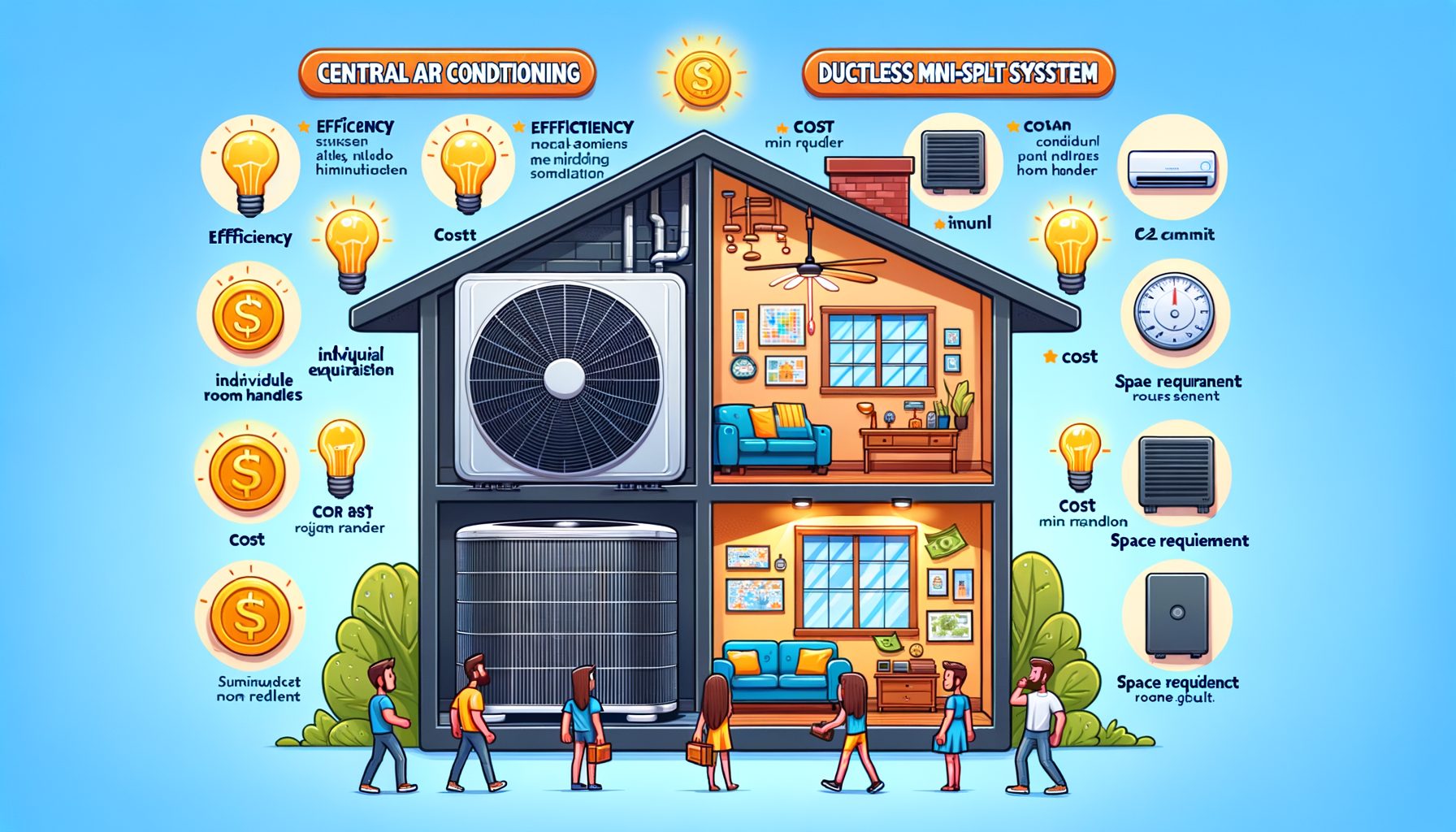
Central AC vs. ductless mini-split is a decision many homeowners and renters face when aiming for efficient cooling (and often heating). Comfort. Bills. Reliability. All three are on the line. If you’ve wondered which option matches your space, climate, and budget, the guide below breaks down the differences in clear, practical terms—so you can choose confidently and get better comfort for less.
The core problem: matching comfort, cost, and climate—and how each system works
People don’t just want cold air; they want the right comfort at the right moment without a surprise on the utility bill. Homes vary wildly—new vs. old, small vs. large, dry vs. humid—while comfort needs remain personal. That’s where the Central AC vs. ductless mini-split debate truly starts: one system sends conditioned air through ducts from a single, centrally controlled unit, while the other targets rooms or zones with compact, high-efficiency indoor units.
With central AC, a single outdoor condenser pairs with an indoor air handler and ductwork. Conditioned air moves through supply ducts to rooms and returns through another set of ducts to be cooled again. That approach delivers whole-home coverage and a clean look (no wall units), yet it depends heavily on duct quality. Leaky or poorly insulated ducts can waste 10–30% of energy before the air reaches you. Efficiency is typically rated by SEER2 for cooling and, when set up as a heat pump, HSPF2 for heating.
Ductless mini-splits connect one outdoor unit to one or more compact indoor air handlers via refrigerant lines. Most are inverter-driven heat pumps that modulate smoothly and provide both cooling and heating. By sidestepping long duct runs, mini-splits often achieve higher real-world efficiency—especially in smaller homes, additions, or retrofits where adding ducts is costly or messy. SEER2 ratings for quality mini-splits often exceed standard central AC, and many offer strong heating performance with HSPF2 ratings suitable for cool and even cold climates (look for “cold-climate” models).
Climate plays a big role. In humid regions, both systems must remove moisture effectively; mini-splits excel at steady low-load dehumidification thanks to inverter modulation, while central systems can perform beautifully with proper sizing and airflow tuning. In very cold climates, pick a mini-split designed for low-temperature heating or a central heat pump with adequate capacity at low outdoor temperatures. In hot, dry climates, distribution and efficiency matter most: central can shine with tight ducts and zoning; mini-splits thrive with room-by-room control.
Central AC vs ductless mini-split: pros, cons, and best use cases
Central AC stands out for whole-home uniformity and aesthetics. When a home already has well-designed ducts, a central system can deliver even cooling (and heating if it’s a heat pump) to every room using a single, familiar thermostat. High-MERV filters are easy to integrate, as are whole-home dehumidifiers or ventilators—boosting indoor air quality. Visual appeal is strong: nothing on the walls, just discreet vents. Noise typically stays remote—most sound remains at the outdoor unit or a closet/attic air handler—so living spaces feel quiet.
Drawbacks appear when ducts are suboptimal or absent. Duct leaks, poor insulation, and imbalanced airflow waste energy and create hot/cold spots. Retrofitting ducts into older homes can be invasive and expensive. Standard single-zone central systems also cool the entire house even when only one room needs it, which can inflate energy use. Zoning dampers help but add cost and complexity. Oversizing—common in practice—can cause short cycling, weaker dehumidification, and higher bills.
Ductless mini-splits win on efficiency and control. Inverter technology lets output ramp up or down with the load, which boosts comfort and saves energy. Zoning is built-in: condition only the rooms you’re using and set different temperatures for sleep, study, or work. Installation is often simpler for retrofits (just a small wall penetration for line sets), and hard-to-cool spaces—attics, garages, sunrooms—are straightforward to serve. Many mini-splits post higher SEER2/HSPF2 ratings than comparable central systems, translating to lower operating costs.
Trade-offs exist. Wall- or ceiling-mounted indoor units aren’t everyone’s favorite look, filters and coils need more frequent cleaning, and multi-zone systems can lose some efficiency if most heads stay off. In very cold climates, choose a model rated for low-ambient heating to avoid capacity drop-offs in deep winter. Line-set routing and condensate management must be handled cleanly to preserve exterior aesthetics and prevent drips. What’s interesting too, proper placement of heads often beats adding more of them.
Best use cases: Medium-to-large homes with tight, existing ductwork and a preference for a central thermostat and invisible indoor equipment point toward a central system (ideally a heat pump for year-round use). Then this: homes without ducts, projects needing room-by-room control, phased retrofits, or smaller spaces and additions seeking maximum efficiency often favor ductless mini-splits as the smartest, most flexible path.
Costs, efficiency, and real-world savings
Costs vary by region, brand, and installer, but clear patterns emerge. Central systems tend to cost more to install in homes without existing ducts; ductless shines in retrofits and targeted projects. Operating costs depend on efficiency (SEER2/HSPF2), local climate, electricity price, and usage pattern (whole-home vs. zoned).
| Category | Central AC / Heat Pump (Ducted) | Ductless Mini-Split (Heat Pump) |
|---|---|---|
| Typical installed cost (USD, broad ranges) | $6,000–$14,000 with existing ducts; $8,000–$20,000+ if new ducts | $2,000–$6,000 per single-zone; $6,000–$15,000+ for multi-zone |
| Cooling efficiency (SEER2 typical) | 14–18 SEER2 (premium up to ~20+) | 18–30 SEER2 (premium models at the high end) |
| Heating efficiency (HSPF2 typical) | 7.5–9.5 (cold-climate models higher) | 8–12 (cold-climate models higher) |
| Maintenance | Filter changes, coil cleaning, duct inspection every 1–3 yrs | Frequent filter rinsing, coil cleaning on each indoor unit |
| Noise | Air handler 40–55 dB(A); outdoor 50–70 dB(A) | Indoor 19–35 dB(A); outdoor 45–60 dB(A) |
| Lifespan (typical) | 12–17 years | 12–20 years |
Example savings snapshot: Suppose you cool an 1,800 sq ft home for 1,000 hours per year at $0.18/kWh. A 3-ton (36,000 BTU/h) system at 14 SEER2 uses about 2,571 kWh per season; at 22 SEER2 it uses about 1,636 kWh. That’s a savings of 935 kWh, worth roughly $168 per year at $0.18/kWh. Over 10 years (ignoring rate increases), that’s $1,680. In hotter climates or higher-cost regions, savings scale up; in mild climates, payback takes longer, yet comfort gains remain.
Rebates and incentives matter. Many countries and regions offer incentives for high-efficiency heat pumps and mini-splits. In the U.S., check federal, state, utility, and local programs; in the EU, look for national or regional energy-efficiency grants; elsewhere, utilities often provide seasonal incentives. Start with official resources like Energy Star’s rebate finder and your local energy authority. Well, here it is: verifying SEER2/HSPF2 ratings and ensuring proper sizing and commissioning often determines whether promised savings show up on your bills.
Efficiency tips that apply to both: correct sizing (avoid oversizing), proper airflow, tight ducts (or no ducts), and smart controls. For central systems, consider zoning or at least a variable-speed air handler to improve part-load performance. For mini-splits, resist overspecifying heads; fewer, well-placed units tend to outperform a larger number of seldom-used ones.
From quote to comfort: installation quality, maintenance, noise, and indoor air quality
Great equipment can deliver poor results if installation is sloppy. Before signing a contract, insist on a proper load calculation (ACCA Manual J or equivalent) rather than rule-of-thumb sizing. For ducted systems, request a duct design (Manual D) and balancing plan; tight, insulated ducts in conditioned space are ideal. For ductless, get line-set lengths, wall penetration details, and condensate routing in writing to avoid future leaks or wall stains.
Commissioning should never be skipped. Installers need to verify refrigerant charge, airflow, static pressure (ducted), and control settings. Mini-splits require careful evacuation of line sets before opening refrigerant lines; central systems benefit from checking supply/return temperatures and ensuring thermostats are configured for multi-stage or inverter operation. A well-commissioned system runs quieter, dehumidifies better, and uses less energy.
Maintenance preserves efficiency. For central: replace or clean filters every 1–3 months; inspect and clean coils annually; have ducts checked every few years for leaks and cleanliness; clear debris around the outdoor unit. For ductless: rinse washable filters monthly in peak season; schedule professional coil and blower cleanings periodically, especially in humid or dusty environments; provide clear airflow to outdoor units and keep drains open. Small tasks pay big dividends in performance and indoor air quality.
Noise and comfort details matter. Mini-split indoor units are exceptionally quiet (often 19–35 dB(A) on low), making them great for bedrooms and home offices. Central air handlers can be quiet, too, when properly isolated and placed away from living spaces. Oversizing increases noise and cycling; right-sizing brings calmer operation and steadier comfort. Smart controls—wireless remotes for mini-splits, smart thermostats for central—enable schedules, geofencing, and energy reporting.
Indoor air quality (IAQ) offers bonus opportunity. Aim for 40–60% relative humidity for comfort and health. Central systems can integrate high-MERV (11–13) filters and whole-home dehumidifiers, or pair with ERVs/HRVs for fresh air. Many mini-split heads include fine filters, but whole-home filtration is easier with ducted equipment or a dedicated filtration system. In any setup, sealing building leaks, controlling indoor pollutants, and ventilating strategically will elevate comfort and health alongside energy savings.
FAQs
Q: Which is cheaper to run: central AC or a ductless mini-split?
A: In many real-world scenarios, a ductless mini-split is cheaper to run because inverter-driven systems modulate output and avoid duct losses. That advantage grows when you cool only occupied rooms. A well-designed, variable-speed central system with tight ducts can be similarly efficient, especially in larger homes where whole-home cooling is routine.
Q: Can a ductless mini-split heat my home in winter?
A: Yes—most mini-splits are heat pumps. Cold-climate models maintain strong capacity well below freezing. Check the unit’s rated capacity at your design temperature (for example, -5°C or -15°C). In very cold regions, pair with supplemental heat or choose a model engineered specifically for low-ambient performance.
Q: Does central AC provide better air quality than a mini-split?
A: Central systems can support larger filters (MERV 11–13) and integrate whole-home dehumidifiers and ventilators, which can improve IAQ. Mini-splits rely on filters in each indoor unit; they’re effective when cleaned regularly but may not match whole-home filtration without add-ons. Either system benefits from source control, ventilation, and careful humidity management.
Q: How long do these systems last?
A: Typical lifespans range from 12–17 years for central systems and 12–20 years for mini-splits, depending on climate, usage, and maintenance. Proper installation and routine service can extend life and preserve efficiency. In corrosive coastal environments and with heavy usage, lifespan often shortens; protective coatings and regular cleaning help.
Q: How many mini-split heads do I need?
A: Fewer, well-placed heads often beat many lightly used ones. One head can serve multiple adjacent rooms if doors stay open and the layout allows airflow. Use a room-by-room load calculation to size heads smartly; oversizing can reduce dehumidification and efficiency. For multi-story homes, consider one head per floor or per thermal zone.
Conclusion
Choosing between central AC and a ductless mini-split comes down to aligning your comfort goals, your home’s layout, your climate, and your budget. Central systems deliver clean aesthetics and whole-home uniformity—especially compelling if you already have quality ductwork and want integrated filtration and humidity control. Ductless mini-splits excel in efficiency, zoning, and retrofit ease—ideal when you want room-by-room comfort, have no ducts, or prefer lower operating costs with surgical control.
Here’s the move: define your goals (quiet bedrooms, lower bills, better air), get a proper load calculation, and request at least two quotes—one for a right-sized, variable-speed central system (if ducts make sense) and one for a high-SEER2/HSPF2 mini-split solution. Ask each contractor to show their sizing math, duct/line-set plan, commissioning checklist, and estimated annual energy use. Check incentives and rebates in your region—they can materially change the payback math. Then choose the proposal that best balances comfort, efficiency, aesthetics, and total cost of ownership.
If you’re ready to act, schedule a home energy assessment, inventory the rooms where comfort matters most, and contact a reputable installer for a load-based quote. Review noise ratings, maintenance requirements, and controls before you sign. A well-chosen, well-installed system will feel almost invisible—quiet, consistent, and affordable to run.
Comfort is a daily experience and a long-term investment. Make the choice that supports your life, your budget, and your climate—and enjoy coming home to air that simply feels right. Which space in your home deserves perfect comfort first?
Helpful resources
– U.S. Department of Energy: SEER2 and efficiency basics — https://www.energy.gov/energysaver/central-air-conditioning
– ENERGY STAR Rebate Finder — https://www.energystar.gov/rebate-finder
– EPA Indoor Air Quality — https://www.epa.gov/indoor-air-quality-iaq
– ASHRAE Ventilation and IAQ Standards — https://www.ashrae.org/technical-resources/standards-and-guidelines
– International Energy Agency (global energy data) — https://www.iea.org
Sources
– U.S. DOE, “Central Air Conditioning” (efficiency, sizing, maintenance): https://www.energy.gov/energysaver/central-air-conditioning
– ENERGY STAR, “Heat Pumps” (ratings, incentives): https://www.energystar.gov/products/heat_pumps_air_source
– EPA, “Indoor Air Quality” (filtration and humidity fundamentals): https://www.epa.gov/indoor-air-quality-iaq
– ASHRAE, “Standards and Guidelines” (ventilation, comfort): https://www.ashrae.org/technical-resources/standards-and-guidelines