
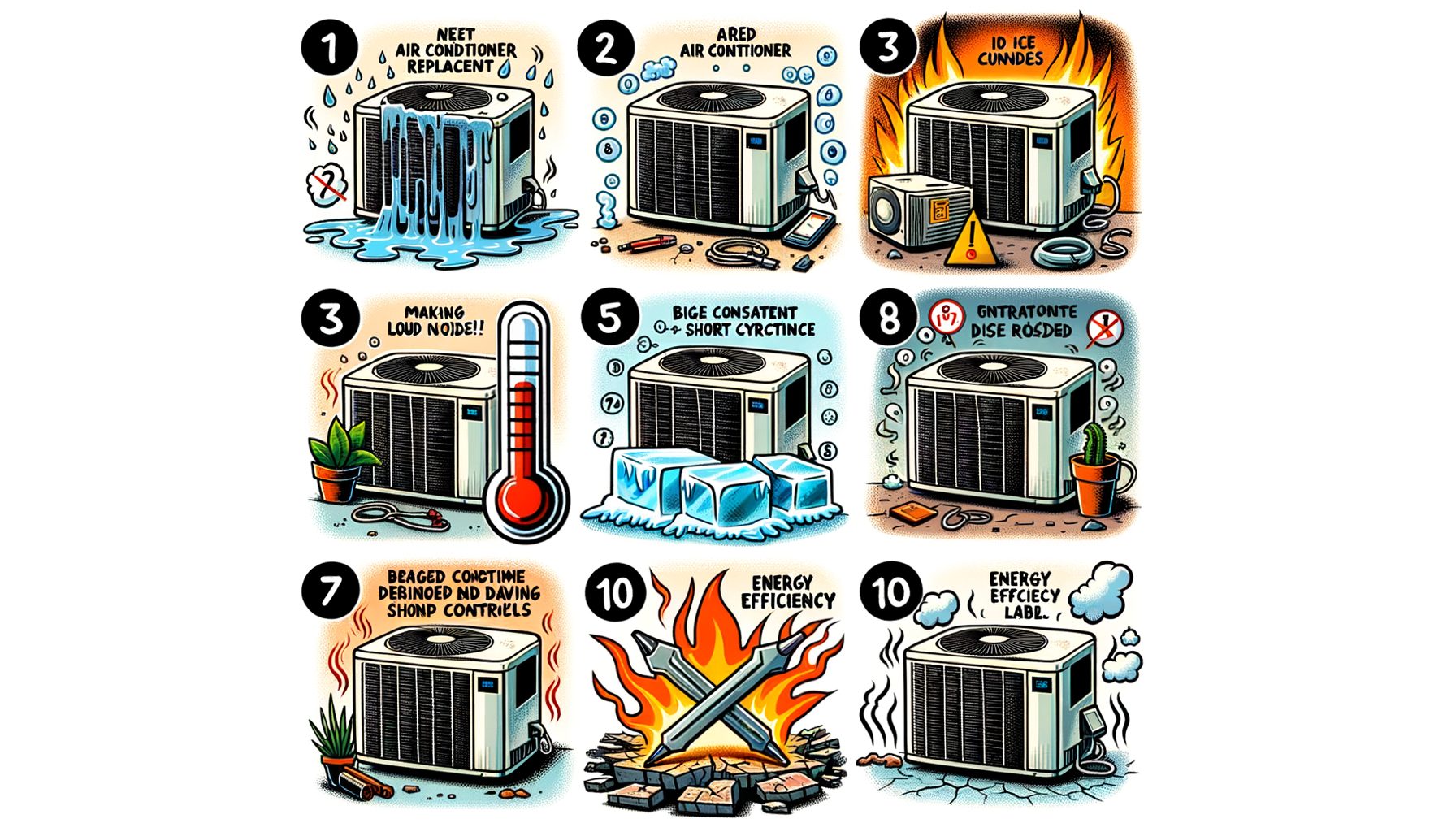
Your home ought to feel like a cool refuge, not a sticky or noisy guessing game. Constant thermostat tweaks, frequent repair calls, and energy bills that climb month after month usually point to a bigger decision: air conditioner replacement. In this guide, you’ll find the most common warning signs that an AC is nearing the end of its useful life, plus tips for separating quick fixes from true red flags and the smartest next steps. Stick around—catching just one of these early can prevent a mid-summer breakdown and lock in lower bills for years.
Performance Red Flags: When Your AC Can’t Keep Up
An air conditioner that can’t cool your space consistently and comfortably is more than an inconvenience. It’s often your first clue that replacement may be wiser than another quick fix. Consider these core performance warnings and how to read them:
1) Endless cycles and rooms that never feel cool enough. When the unit runs nearly nonstop in ordinary weather or never quite reaches the setpoint, performance is being undermined somewhere. The usual suspects: a tired compressor, worn capacitors, grime-packed coils that choke off heat transfer, or a unit that’s undersized—or simply old. Sure, a clogged filter is a fast DIY fix. But if long cycles keep returning, efficiency is slipping and components are overheating. That wear accelerates failure, turning today’s discomfort into tomorrow’s big-ticket repair.
2) Frequent breakdowns and repeat repairs. One summer service call isn’t a crisis; patterns are. If you’ve scheduled multiple visits in the past 12 months—especially for major parts like the blower motor, control board, or compressor—you may be pouring money into a system that won’t recover. Technicians’ field logs show repeat failures often cluster in the final 20–30% of an AC’s life. And a unit that’s repeatedly down erodes comfort, raises stress, and risks peak-season failure when techs are overbooked and parts take longer to arrive.
3) Weak airflow or warm air from the vents. Dropped air volume or lukewarm supply air can signal duct restrictions, a failing blower, low refrigerant from a leak, or compressor wear. Some airflow problems are fixable. Warm air, however, points to deeper trouble. Low refrigerant due to leaks is especially concerning—topping off without finding and fixing the leak becomes an expensive loop.
Next steps: change the filter, open up any blocked supply and return vents, and gently clear debris from the outdoor coil (power off first). If those moves don’t normalize performance, book a professional evaluation. When a technician flags multiple major components as marginal, it’s time to weigh replacement against compounding repair costs.
Cost and Energy Clues: Your Bills and Repairs Are Telling You Something
Even when the AC still cools, your wallet may be sounding the alarm. Energy use and repair spending are objective signals, and they often reveal the real cost of keeping an old system alive.
4) Energy bills rising year-over-year (adjusted for similar weather). Compare this summer’s bills to last year’s for the same months. Weather and rates do vary, yet a steady upward trend often points to declining efficiency: worn compressors and fans draw more power, dirty coils force longer cycles, and aging controls waste energy. Modern systems—especially inverter-driven models—can trim cooling energy by 20–40% versus older units, which shows up directly as lower bills.
5) Repairs add up fast or approach replacement cost thresholds. A common rule of thumb: replace if a single repair will cost over 50% of a new system, or if repair cost multiplied by equipment age exceeds 5,000 (use your local currency). Example: a $600 repair on a 12‑year‑old unit (600 × 12 = 7,200) is a strong nudge toward upgrading. Also look at the season’s total: two or three medium repairs often exceed the monthly payments on a high‑efficiency replacement.
6) Obsolete refrigerant or hard-to-find parts. Systems running R‑22 (HCFC‑22) are effectively obsolete in many countries; supply is scarce and costly, so leak repairs become expensive and uncertain. Even R‑410A (an HFC) is being phased down in several regions, pushing manufacturers toward lower‑GWP refrigerants. If your technician notes that parts or refrigerant are hard to source, consider that a direct nudge toward replacement—before a failure leaves you stuck mid‑heatwave.
To visualize how age and efficiency influence costs, consider this quick overview. Metrics vary by region (SEER, SEER2, EER, CSPF), yet the pattern remains clear: newer systems cool more with less energy.
| Install Era / Age | Common Refrigerant | Typical Seasonal Efficiency | Estimated Energy Use vs. SEER 10 Baseline |
| 15–20+ years (pre-2006) | Often R‑22 | SEER ~8–10 | 100–125% (baseline or worse) |
| 10–15 years (2006–2014) | R‑410A common | SEER ~13–14 | ~70–77% of baseline (23–30% savings) |
| 5–10 years (2015–2022) | R‑410A | SEER ~14–16 | ~62–71% of baseline (29–38% savings) |
| Newer (2023+) | Transitioning to lower-GWP in some markets | SEER/SEER2 15–20+ or high CSPF | ~50–67% of baseline (33–50% savings) |
Note: Efficiency metrics differ globally. Always compare like-for-like in your country. For guidance, see ENERGY STAR and your local standards.
Comfort, Health, and Noise Indicators You Shouldn’t Ignore
Comfort involves more than temperature alone. Humidity control, air quality, and sound levels shape how your home feels. When those go sideways, equipment may no longer be operating within design tolerances—and fixes often run deeper than a quick cleaning.
7) High indoor humidity, clammy rooms, or musty smells. A healthy AC doesn’t just cool; it dehumidifies. If the home feels sticky at normal setpoints, the system may be short cycling, oversized, or losing coil performance. Oversized units blast cold air quickly and shut off before removing enough moisture. Aging systems can also struggle to wring out humidity. Musty odors often indicate microbial growth on wet coils or in drains—issues that tend to return if underlying performance isn’t restored. Persistent humidity problems affect indoor air quality and comfort, signaling the need for a right‑sized, modern unit with stronger latent (moisture) control.
8) Unusual noises and short cycling. Grinding, buzzing, rattling, or screeching are more than annoyances; they’re mechanical clues. A failing compressor or fan often gets loud before it dies. Electrical hums or rapid on/off clicking paired with short, frequent cycles usually mean the system is struggling to start or keep running. Short cycling is punishing: it accelerates wear and slashes efficiency and humidity control. After simple causes (loose panels, debris) are ruled out, persistent noises suggest a major component failure may be near—where replacement becomes the more reliable, economical path.
9) Leaks, corrosion, or frozen coils. Water around the air handler or ice on refrigerant lines points to poor heat exchange, low airflow, or a refrigerant issue. Clearing a clogged condensate drain is straightforward, but repeated leaks risk water damage or mold. Corrosion on coils or fittings often tracks with age and environmental exposure (coastal air, pollution). If coils refreeze even after filter changes and cleaning, deeper causes—low refrigerant from a leak or a failing blower—may be at play and costly to solve on an old system.
If sticky air, odd sounds, and recurring freezes show up together, assume the system is on borrowed time. A professional load calculation and assessment can confirm whether a modern variable‑speed or inverter system would improve both comfort and energy use.
Age, Technology, and Home Changes That Point to Replacement
Even a well‑maintained system reaches a point where newer technology—and changes in your home—make replacement the sensible choice.
10) Your system is 10–15+ years old—or no longer matches your home and lifestyle. Age isn’t everything, but it matters. In hot or coastal climates, many systems hit practical replacement age around 10–12 years; in milder climates, 12–15 years is common. Beyond that, efficiency slides, parts get harder to source, and big‑ticket failures grow more likely. If you’ve remodeled, added rooms, sealed or unsealed areas, or changed how you use spaces (home office, nursery, gym), the old sizing may now be wrong. Oversizing causes short cycles and humidity issues; undersizing leads to long cycles and hot spots.
Modern systems bring features aging units can’t match: inverter‑driven compressors for precise temperature and humidity control, multi‑stage or variable‑speed fans for quieter operation, and smart thermostats that optimize for comfort and savings. Many regions also offer rebates or tax incentives for high‑efficiency heat pumps or AC upgrades—financial support you won’t get by repairing an old unit. If you plan to stay in your home for a few years, the combined benefits of comfort, lower bills, and better resale appeal often outweigh patchwork repairs.
Before you replace anything, ask an HVAC professional for a Manual J (or regional equivalent) load calculation, a ductwork inspection, and a written comparison of at least two efficiency tiers. Also check local programs through utilities and government agencies; resources like the U.S. Department of Energy and the International Energy Agency offer impartial guidance and current trends. If your system is older and at least two of the earlier warning signs apply, plan a proactive replacement—ideally off‑peak—to save stress and money.
Q&A: Fast Answers to Common AC Replacement Questions
How long does a typical air conditioner last? Most central ACs and split systems run 10–15 years, depending on climate, maintenance, and usage. Coastal, dusty, or very hot regions shorten lifespan. Regular filter changes, coil cleanings, and annual tune-ups can add years, though efficiency will still decline over time.
Should I repair or replace? Use two quick checks: 1) Replace if a single repair exceeds about 50% of a new system’s cost. 2) Replace if repair cost × system age exceeds 5,000 (local currency). Also weigh energy savings, warranty coverage, comfort improvements, and available rebates.
Can I replace just the outdoor unit? Mixing an old indoor coil with a new outdoor unit can reduce performance, void warranties, and hurt reliability. A matched system is usually required for rated efficiency and manufacturer support. Have a pro confirm compatibility before attempting partial changes.
What size AC do I need? Proper sizing requires a load calculation (Manual J or regional equivalent). Square footage alone isn’t enough; insulation, windows, orientation, air leakage, and local climate all count. Both oversizing and undersizing harm comfort and efficiency.
When is the best time to replace? Off-peak seasons (spring or fall) often bring better scheduling, less downtime, and sometimes better pricing. If multiple red flags are present, don’t wait—proactive replacement avoids emergency premiums and rushed decisions.
Conclusion
Bottom line: an AC that runs forever without reaching setpoint, breaks down repeatedly, blows weak or warm air, drives up energy bills, relies on scarce refrigerant, struggles with humidity, makes worrying noises, leaks or freezes, and is a decade or more old—or no longer fits the home—is signaling that replacement is the smarter move. Modern systems deliver tighter temperature control, stronger humidity management, quieter operation, and meaningful energy savings that compound month after month.
Take action now. Schedule a professional assessment, request a proper load calculation, and get at least two quotes that compare efficiency tiers. Verify warranty terms, ask for a ductwork check (leaky ducts waste money), and explore incentives from your local utility or government. In warm climates—or if you’ll stay in the home for several years—consider a high-efficiency inverter system or a cold-climate heat pump for year-round comfort. Pair the new unit with a smart thermostat and regular maintenance to lock in performance.
Proactive planning beats emergency replacement every time. The moment you see two or more of the warning signs above, start gathering information and quotes so you can choose on your timeline—not in a heatwave. Your future self (and your energy bill) will thank you. Ready to breathe easier and spend less? Book a consultation this week, compare your options, and step into a cooler, quieter, lower-cost home. What’s the first upgrade you’ll prioritize: right sizing, inverter tech, or sealing those leaky ducts?
Sources and Further Reading
ENERGY STAR: Central Air Conditioners
U.S. Department of Energy: Central Air Conditioning
U.S. EPA: Phaseout of Ozone-Depleting Substances (R‑22 and others)
International Energy Agency: Cooling